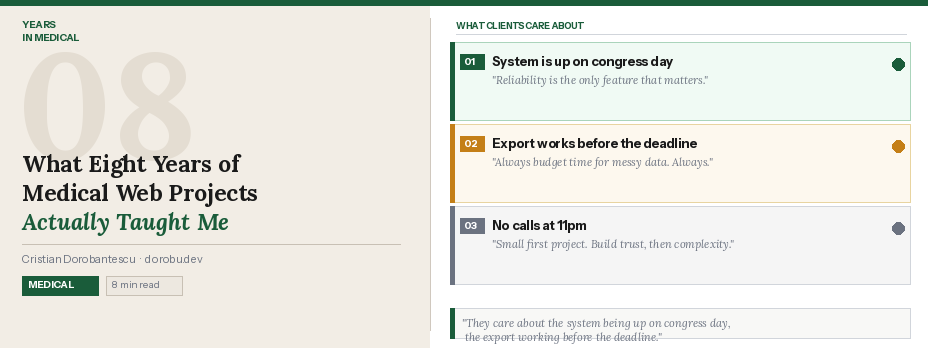
Medical clients don’t care about clever architecture. They care about the system being up on congress day, the export working before the deadline, and not having to call you at 11pm. Eight years in, here’s what I’ve actually learned.
Reliability Is the Only Feature That Matters
I’ve built membership platforms, conference registration systems, patient registries, data dashboards, and reporting tools for medical organizations. In that time, I’ve shipped things I’m proud of and things I’d build differently today. But the single most consistent truth is this: if your system is down on the day it matters, nothing else about your work is relevant.
Medical conferences happen once a year. Registration deadlines are real. When 400 doctors try to register on the last day before a deadline and the server can’t handle the load, you hear about it immediately — and the client remembers it for years.
Everything else in your architecture is secondary to: will this be up when it needs to be up?
Medical Organizations Move Slowly — Work With It, Not Against It
Early on I made the mistake of trying to introduce too much at once. New CMS, new design system, new registration flow, new payment processor — all in one project. The result was a six-month delay, scope creep in every direction, and a client who was anxious about every change because there was too much to evaluate at once.
Now I scope projects differently. The first engagement with a new medical client is always small and low-risk: migrate the existing site to a stable platform, clean up the data, establish a deployment process. Build trust before building complexity.
The Data Is Always Messier Than You Think
Every medical organization I’ve worked with has years of member data in formats that range from “slightly inconsistent” to “actively wrong.” Phone numbers in the email field. Names split differently across different years. Membership statuses that were last updated in 2017.
Budget significant time for data cleaning on any project that involves migrating or consolidating records. The technical migration is usually straightforward. The data quality issues are where projects go over budget.
Export Functionality Is Not Optional
Every system I build for medical clients now includes robust CSV and Excel export for every data set they care about. Not because they’ll use it every day — they won’t — but because when the board needs a membership report at 48 hours notice, or the conference venue needs an attendance list in a specific format, the ability to export clean data is the difference between a normal day and a crisis.
If I had to pick one feature that has saved client relationships more than any other, it’s a well-built export function.
On Introducing AI to Conservative Clients
I’ve started introducing AI-assisted features to some of my longer-standing medical clients — automated summarization of meeting notes, intelligent search across member records, draft generation for routine communications. The reception has been better than I expected, with one consistent pattern: clients don’t want to know it’s AI. They want to know it works reliably and that a human reviewed the output before it went anywhere important.
That’s actually a reasonable position. Build the AI layer to assist, not to fully automate. Present it as a tool that makes the humans more efficient, not a replacement for human judgment. Medical professionals are appropriately skeptical of systems that make consequential decisions without oversight — and they should be.
The Long Game
My oldest active medical client relationship is seven years. That’s not unusual in this space — if you build reliable systems and respond when things go wrong, medical organizations tend to stick with you. They’re not chasing the latest framework or looking to rebuild every two years. They want a system that works and someone they trust to maintain it.
The implication for how you price and scope work: don’t optimize for project revenue, optimize for relationship continuity. A smaller initial project that goes well is worth more than a large project that introduces enough friction to damage trust.